Why Your Cab Quote Isn't a Number Pulled Out of Thin Air
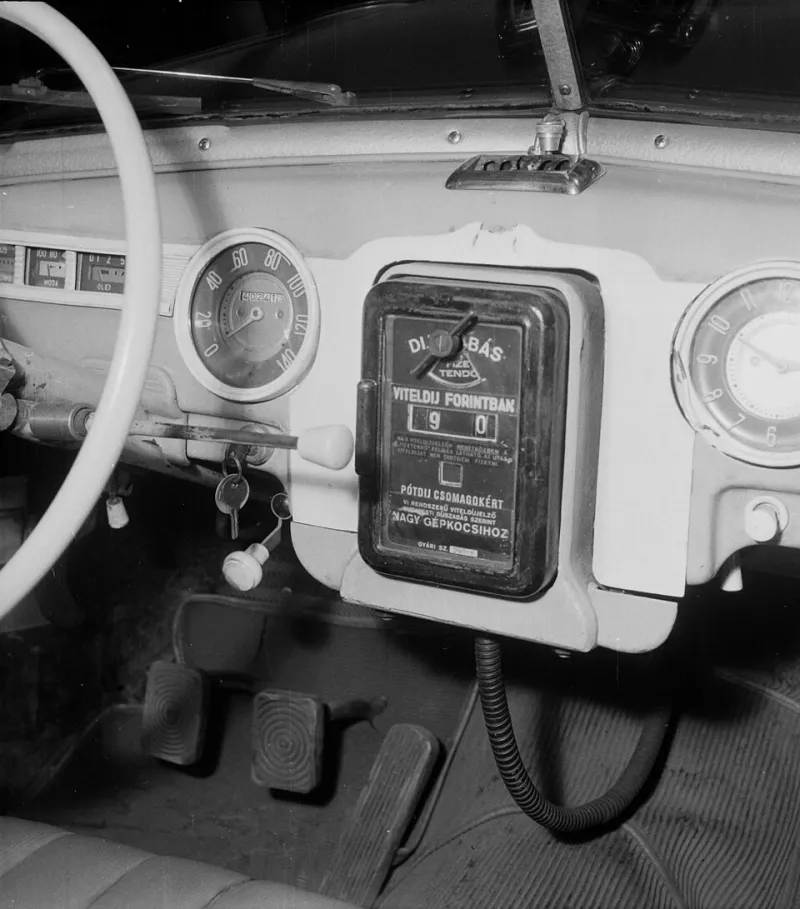
Photo: FOTO:Fortepan — ID 104251: Adományozó/Donor: Budapest Főváros Levéltára. archive copy at the Wayback Machine, CC BY-SA 3.0, via Wikimedia Commons
Ask ten people on a Lancing platform what a cab to Gatwick should cost and you'll get ten answers, most of them delivered with total confidence and none of them checked against anything. Fares feel arbitrary from the outside. They aren't. They're arithmetic, plus a bit of local judgement about traffic and timing.
Here's what's actually inside the number.
Three ingredients, one price
Almost every local quote comes down to distance, time and tariff band. Distance is the easy bit. Time is the bit people forget: a four-mile run along the A259 at 3:20pm on a weekday is not the same journey as the same four miles at 9pm on a Sunday, and any honest quote reflects that. Tariff band is the published schedule most firms operate — day rate, evening rate, night rate, sometimes a weekend or bank holiday rate. Ask when the night rate kicks in. It's often 10pm or 11pm, and a booking at 9:55pm can price very differently from one at 10:05pm.
The quote is not always the meter
There are two ways to buy a cab. Metered, where the price builds as you go, and fixed, where the operator quotes a number for a known journey and that's what you pay. For anything planned — a hospital appointment, a flight, a school run — fixed is almost always the better deal for you, because the firm carries the risk of traffic rather than you. For a spontaneous hop across town, the meter is fair enough.
The thing worth asking, every single time: is this a fixed price or an estimate? Those are different words and they mean different things.
Waiting time: the quiet line item
Waiting is where quotes and final bills most often drift apart. Standard practice locally is a few minutes free at pickup, then a per-minute charge after that, sometimes rising to an hourly rate for long waits. Airport pickups are the classic case: a flight lands, baggage takes forty minutes, and the meter has been running since the scheduled landing time.
If you're meeting someone off a plane, ask whether the firm tracks the flight number and adjusts the pickup. Most decent operators do. Also ask how the waiting is calculated — from the scheduled time, the actual landing, or the moment the driver arrives at the terminal.
Airport runs: the fees inside the fee
The headline airport price often contains more than the cab. Gatwick and Heathrow both charge for vehicle drop-off, and that charge has to land somewhere. Some firms fold it into the quote; some add it on the day. Neither is dishonest, but you're entitled to know which one you're getting.
Meet-and-greet is the other variable. Being met in arrivals means the driver pays for terminal parking, and that cost appears in the price. Being dropped at the departures kerb is cheaper but involves a short walk with the suitcases. Both are perfectly reasonable — just don't compare a meet-and-greet quote with a kerb-drop quote and conclude one firm is ripping you off.
When you book, ask three things: is the drop-off charge included, is the price fixed, and what happens if the flight is delayed.
Peak demand, and the Friday 5pm problem
Most local firms don't do the app-style surge pricing that makes headlines. What they do have is a published tariff, and demand that bunches up around it. Friday afternoon school traffic plus commuter traffic plus the general gravitational pull of the coast on a sunny evening is a genuinely slow combination. Saturday nights after about 11pm are another one.
Booking ahead doesn't dodge the tariff, but it does mean you're not ringing round at the last minute hoping. And a firm that has your booking knows to send a car early rather than send one late.
Extras that are fair, extras that raise an eyebrow
Fair: luggage and oversized bags, extra stops en route, a pickup outside the usual operating area, a child seat, a larger vehicle for six people and a week's shopping, waiting time beyond the free minutes, and cancellation within a short window.
Worth a polite question: a price quoted per person rather than per vehicle, an unexplained admin or booking fee that appears after the quote, or a figure that was described as a fixed price and then treated as an opening bid. None of these are common among established local operators, but they exist, and asking costs nothing.
Six ways to keep the number down
- Book ahead and take the fixed price. A pre-booked journey is almost always cheaper than a same-day scramble, and it removes the traffic risk from your side of the table.
- Travel outside the pinch points. Leaving at 9:30am rather than 8:30am, or at 6:30pm rather than 5:15pm, can make a real difference on a longer run.
- Choose a pickup the driver can actually reach. A legal, pull-in-able spot beats a hopeful wave from a bus stop, and it stops waiting time ticking.
- Share the car. Two households, one vehicle, split fare. Simple and effective.
- Be ready when the car arrives. Free waiting minutes evaporate fast when someone's still looking for their shoes.
- Ask about accounts and repeat bookings. Regular school runs, weekly commutes and hospital trips are worth a conversation about a standing arrangement.
What to ask when you ring
A short script: how much, fixed or estimate, is the airport charge included, how many minutes of waiting are free, what's the cancellation policy, and can you confirm the vehicle size. Six questions, two minutes, and you'll know exactly what you're buying.
Cheap is not the same as cheap
The lowest quote in the county is no bargain if the car doesn't turn up at 4:40am for the airport run. Reliability has a price, and it's usually a couple of pounds — a good deal less than a missed flight. Read the quote properly, ask the six questions, then pick the firm you'd actually want knocking on the door at an ungodly hour.